hero2026a.png

News / Articles

September 2026 Saddle Post Intelligencer Newsletter

Anita L Elder | Published on 9/11/2026
Saddle Post Intelligencer Newsletter
September 2026
President's Report by Barry Antler

Call off the Dogs!

On a recent club ride, I found myself pondering what topic to use for my next President’s Report. Suddenly—out of nowhere—an aggressive dog came charging straight at me on my bike. There was my answer. After doing a bit of research, here are some practical tips worth keeping in mind if you ever find yourself in the same situation. The goal is simple: de‑escalate first, protect yourself second, and avoid triggering the dog’s chase instinct.

What to do as the dog approaches

  1. Stay calm and stop sudden movement -- Dogs are triggered by fast motion. Sprinting or panicking increases their chase drive.
  2. Slow down or stop and dismount -- If the dog is close or determined, dismount and place your bike between you and the dog as a barrier.
  3. Stand sideways, tall, and non‑threatening -- Facing sideways reduces your profile and is less confrontational. Avoid direct eye contact, which can escalate aggression.
  4. Use a firm, deep voice -- Commands like “NO!”, “STAY!”, or “GO HOME!” often work because many dogs recognize them.
  5. Create a barrier -- Your bike, backpack, or even a water bottle held out can signal “back off” without escalating.

If the dog escalates or attacks

  1. Protect limbs -- Use your bike or bag to shield arms and legs.
  2. Use deterrents -- Humane deterrents can stop an attack long enough for you to retreat:
    • Citronella spray
    • Air horn
  3. Ultrasonic dog deterrent These are widely used by U.S. cyclists and postal workers.
  4. Water works too -- Even a squirt from your bottle can interrupt a lunge.
  5. If knocked down -- Curl into a ball, protect your face, neck, and ears.

Prevention for future rides

  1. Know your routes -- Avoid areas known for loose dogs.
  2. Stay on the road -- Dogs are more likely to chase from yards or trails.

I have not personally tested (nor do I care to) any of the suggestions mentioned above, but if you’ve had any experience with any dog vs cyclist encounters, please do not hesitate to share them with our members.

Leadership Roles

The Skagit Bicycle Club is seeking members willing to step into several key leadership positions that keep our organization running smoothly. We are currently looking for a Treasurer and Vice President—all essential roles that support our rides, events, and communication. If you have the time, skills, or interest in contributing, we’d love to hear from you. Serving in one of these positions is a meaningful way to give back to the cycling community and help shape the future of the club. Please, we would like to get the slate filled before our annual meeting in October when members vote to select our officers for the coming year. Longtime graphic designer and newsletter editor, Anita Elder will be stepping down at the end of the year so we are also looking for a Newsletter Editor. If you have any experience, or are willing to learn, we would love to have you on board.

Below is the current candidate slate as follows:

Past President: Barry Antler (President in 2026)

President: Steve Moe (Current board member)

Vice President:

Treasurer:

Secretary: John Laudermilk

Board Members: Jacqui Ilman, Craig Ilman, Lynette Tomaso, Jennifer Streng-Roberts

Look for short bios of the candidates and any additions to the slate in the October newsletter.

Rides

Summer is winding down in the Skagit Valley, but you wouldn’t know it—the weather continues to allow for some wonderful cycling. Attendance for our weekly rides is up, and it has been great fun spending time riding and socializing all around the valley.

As has been discussed in our past newsletter the ride leaders met to talk about club engagement and how we can grow participation in the rides and hopefully membership. To that end we’ve been offering a wide range of ride opportunities (in addition to our typical Tuesday/Thursday offerings) throughout the summer and early fall.

The Summer Concert Series (July/August) culminated with a picturesque ride in the hills, past four lakes and through some lovely farm country just to the north of Mount Vernon. We happened upon a herd of mares with their young foals as they sprinted across their pasture. It was quite a sight to behold! The rides garnered a decent turnout with more members joining in for the music afterwards.

Three Island Series – Steve Jahn led a ride to Orcas Island in June, and Steve Moe led one to Lopez Island in August. Both rides were a blast! What’s there not to like about the San Juans? Be on the lookout in the September Event Callander for the final ride in the series –San Juan Island.

There were a couple of gravel rides on sections of the Cascade Trail. Be looking for a Baker Lake Road Fall Colors ride that we have planned.

Presentation of the winner of the Summer Ride Series and Promotion.

The Club will be providing a $150 restaurant gift card to the member who has participated in the most club-sponsored rides during the period of May 1 – September 30. You still have a chance to up your game and possibly walk away with the gift card. The winner of the promotion will be announced during the annual meeting in October. Participation in the Spring Classic is excluded, and Ride Leaders are not eligible to participate.

If you have a favorite ride you want to share you can share ride details to steven.moe@me.com and we will work to get it into our weekly offerings.

Skagit Bicycle Club’s Annual Picnic

Our annual summer picnic was held Saturday, August 8th at Riverfront Park, in Sedro‑Woolley. The rides went well followed by Kelly’s BBQ providing scrumptious food. It certainly seemed that a good time was had by all!

Marathon and Half Marathon Volunteers Needed

Skagit Runners is looking for volunteers to lead/pace and sweep for their 49th Annual Skagit Flats Marathon, Half Marathon, and 5K! The event will take place on September 13th beginning at 8AM. Renowned as the flattest Boston qualifier in Washington, this race offers a picturesque route through the scenic Skagit Valley farmlands, finishing on the Burlington-Edison High School track.

If you are interested, please contact Kiera Wright at (313) 727-8425, or email her at: skagitrunnersrd@gmail.com

Safety Tip of the Month:

The League of American Bicyclists says, Be Conspicuous. Use a front white light, red rear light and reflectors when visibility is poor. Make eye contact with others and don’t ride on sidewalks. Ride where people can see you and wear bright clothing. And what better way to be conspicuous than by wearing a Skagit Bicycle Club jersey (beautifully designed by Anita Elder). Follow the Club Store link on the website to purchase one for yourself or for a friend. I recently had a friend from Germany staying with me who was so impressed with our jerseys that he ordered one for himself. Now if I could just figure out how to get it to him Germany without paying up the nose.

You don’t have much time left to enter your funny/ironic bicycle safety tip in the Funniest Safety Tip of the Month Contest. The winner will receive a $50 gift certificate to Skagit Cycle Center to be awarded at the Annual meeting in October.

New Members

A hearty welcome to our newest members: Jeff Ernst and Bruse Stokstad.

Club News

Skagit Bicycle Club
Annual Meeting and Dinner

The 2026 SBC Annual Meeting will be held on Wednesday, October 7th at 6pm at the Mount Vernon Library/Commons, 208 W Kincaid St. Mount Vernon, WA. Please enter via the doors on the corner of Kincaid and 3rd Streets. (Northeast corner). There is plenty of parking in the lot above the library -- enter off S 3rd St.

Dinner will be provided by the club. Spiced dry rub salmon and Dublin broil will be catered by Shawn O’Donnell’s Farmhouse. An assortment of soft drinks will also be provided-- alcohol is permitted on the premises (BYOB).

After the meal we will hold election of officers and miscellaneous club business.

This year’s guest speaker will be Anita Elder

Anita will be reading from and promoting her new book, Finding Freedom on Two Wheels: How Two E-Bikes Helped Me Reclaim My Health, Confidence, and Sense of Adventure.

“This book isn’t just about riding e-bikes. It’s about discovering that life doesn’t stop because we get older. Sometimes all it takes is finding something that reminds us we’re still capable of more than we ever imagined. If you’ve ever thought, ‘It’s too late for me,’ I hope my story changes your mind.”

And if you’re looking for an inspiring read—or know someone who could use a little encouragement—you can find Finding Freedom on Two Wheels on Amazon in paperback and Kindle versions (audiobook coming soon. Anita will have a few paperback copies of her book hand-outs with the URL and QR code for easier ordering.

Please plan to attend on October 7th. You can register by clicking on the date on the event calendar on the SBC website (the same process as signing up for a ride). Please RSVP by Wednesday, September 30th, so we can provide a headcount to the caterer. However, if you forget to do so and would like to attend at the last minute, please join us -- usually there is extra food, and we'd welcome your participation.

We hope to see you there! Please feel free to bring a guest.


Cycling News

Why Bicycling After 40 Is One of the Best
Things You Can Do for Your Health

by Kristi Blanchard

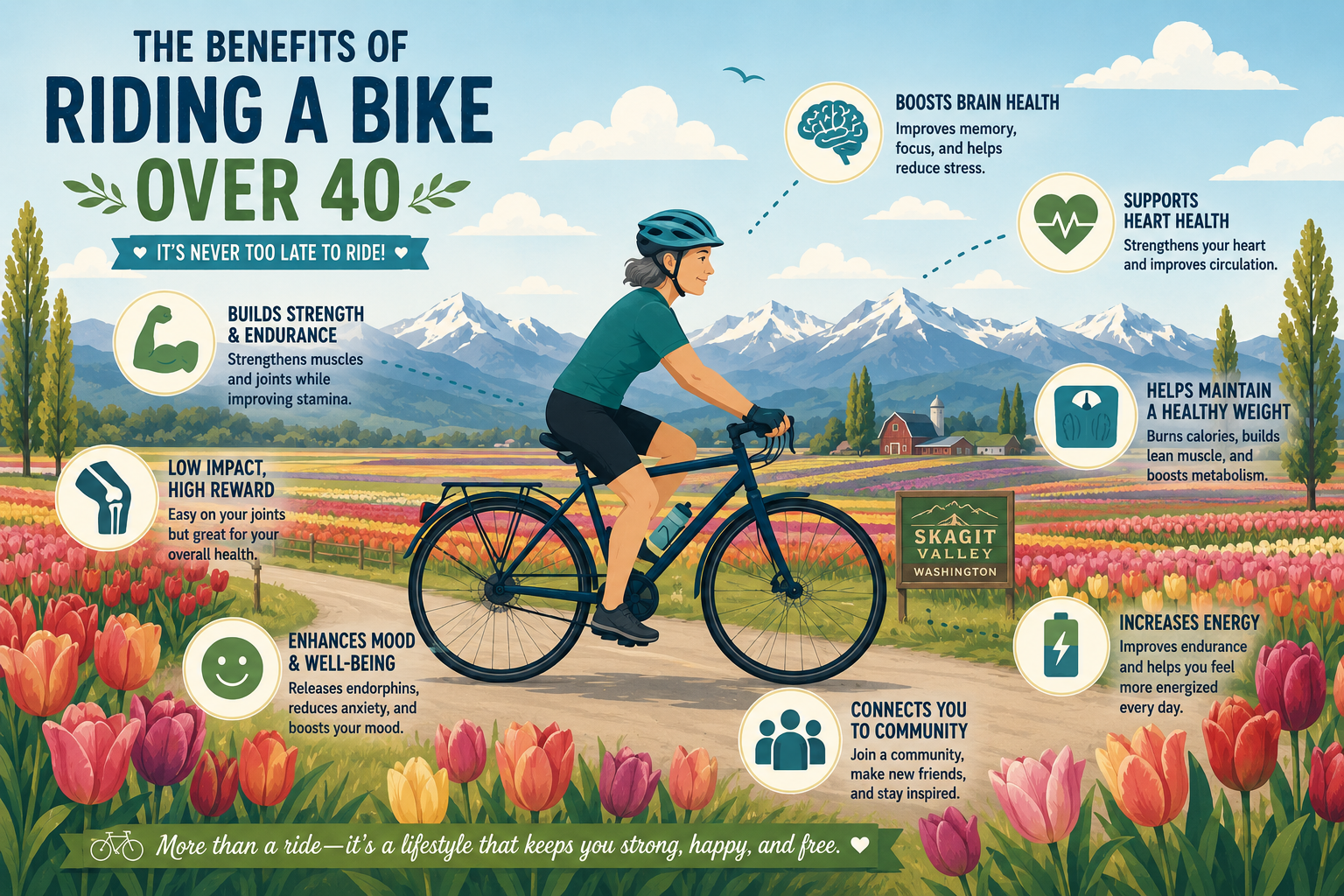
Turning 40 is often treated as a milestone when the body supposedly begins to slow down. But reaching your forties is not a reason to stop being active—it can be one of the best times to become more intentional about fitness. Bicycling is an especially effective way to stay active because it combines cardiovascular exercise, muscular endurance, mobility, and the simple enjoyment of being outdoors.

Whether you are returning to cycling after many years or have been riding consistently, there is strong evidence that continuing to bicycle as you age can support long-term health and quality of life.

A Stronger Heart and Cardiovascular System

One of the greatest benefits of bicycling is cardiovascular fitness. Cycling gets the heart beating faster and challenges the lungs and circulatory system without requiring the repeated impact associated with activities such as running.

Research has consistently linked cycling with better cardiovascular health. A systematic review and meta-analysis involving more than one million people found that cycling was associated with lower risks of cardiovascular disease and cardiovascular-related outcomes.

Another large meta-analysis found that people with the highest levels of cycling had lower risks of both all-cause mortality and cardiovascular mortality compared with those with the lowest levels of cycling. These studies are observational, so they show an association rather than proving that cycling alone causes the reduction in risk, but the overall evidence strongly supports cycling as a health-promoting activity.

For someone over 40, that matters. Cardiovascular disease risk generally becomes more important with age, making regular aerobic activity an investment in future health.

Cycling Helps Maintain Fitness as You Age

Muscle mass, aerobic capacity, flexibility, and physical function can gradually decline with age, particularly when people become less active. Cycling provides a practical way to keep the body working.

Pedaling repeatedly challenges the legs, hips, and core while also improving endurance. Regular cycling can help maintain the ability to perform everyday activities without becoming exhausted.

Research specifically examining older cyclists has found associations with better mobility, balance, leg strength, and cardiometabolic health. A 2026 systematic review of 28 studies concluded that cycling in later life is associated with improvements in several aspects of physical function and quality of life.

The important lesson is that getting older does not mean you have to surrender physical fitness. Staying active helps you preserve it.

Cycling Can Be Easier on the Joints

For many people over 40, high-impact exercise becomes less appealing. Previous injuries, stiffness, or simply the cumulative effects of decades of activity can make running and jumping uncomfortable.

Cycling provides cardiovascular exercise while supporting much of your body weight on the bicycle. That makes it an attractive alternative for people who want challenging aerobic exercise without the same repetitive impact as running.

It is also easy to adjust the difficulty. You can ride slowly on flat roads, increase resistance on an indoor trainer, climb hills, or gradually increase distance as your fitness improves.

That flexibility makes bicycling accessible to a wide range of fitness levels.

It Can Support Healthy Weight Management

Metabolism and body composition often change with age, but regular physical activity remains an important part of maintaining a healthy weight.

Cycling burns energy while building endurance, and longer rides can provide a substantial aerobic workout. More importantly, cycling can be an activity people enjoy enough to perform consistently.

Consistency is critical. A moderate bike ride several times a week is generally more useful than an extremely difficult workout that you perform only occasionally.

Cycling can also become part of everyday transportation. Riding to work, running errands by bicycle, or taking a short evening ride can turn exercise into a normal part of life rather than another appointment on the calendar.

The Mental Health Benefits Matter Too

Fitness after 40 is not only about the heart and muscles. Mental well-being becomes increasingly important as people balance careers, families, responsibilities, and the stresses of everyday life.

Physical activity can improve sleep, reduce anxiety, and support mental health. The CDC notes that regular physical activity can help keep thinking and learning skills sharp as people age and can reduce the risk of depression and anxiety.

Cycling adds another dimension: time outside and, for many riders, a sense of freedom.

There is something different about traveling under your own power. A bike ride can provide an opportunity to disconnect from a computer or phone, experience nature, explore a neighborhood, or simply spend an hour thinking without the usual distractions.

Recent research involving older cyclists has also found associations between cycling and greater life satisfaction, well-being, and psychosocial health.

Bicycling Can Help You Stay Independent

One of the most important goals of healthy aging is maintaining independence.

Being able to walk comfortably, climb stairs, carry groceries, travel, and participate in social activities depends heavily on physical function. Regular physical activity can help preserve that function.

The CDC recommends that adults 65 and older accumulate at least 150 minutes of moderate-intensity aerobic activity each week, along with muscle-strengthening activities and balance exercises. Riding a bicycle can count as aerobic activity, although cycling should ideally be complemented with strength and balance training as you get older.

In other words, bicycling does not have to be an activity you eventually "outgrow." It can be part of a lifelong fitness routine.

You Don't Have to Be a Racer

One misconception about cycling after 40 is that you need an expensive bicycle, racing experience, or the ability to ride dozens of miles.

You don't.

A 20-minute ride around the neighborhood is worthwhile. So is a relaxed ride with friends. An indoor stationary bike can be useful when weather or traffic makes outdoor riding impractical.

The goal is not necessarily to become faster. The goal is to keep moving.

As your fitness improves, you can gradually add distance, hills, cadence, or intensity. There is no requirement to compete with the younger cyclist passing you on the trail.

Your most important competition is inactivity.

Start Gradually and Ride Wisely

Cycling is generally a safe form of physical activity, but aging does mean that recovery, strength, balance, and injury prevention deserve greater attention.

If you have not exercised regularly, start with shorter, easier rides and gradually increase your duration and intensity. Make sure your bicycle fits properly, wear a properly fitted helmet, use lights and reflective equipment when appropriate, and choose routes that match your riding ability.

It is also important to remember that cycling alone does not provide everything the aging body needs. Add resistance training to maintain muscle and bone strength, and include exercises that challenge balance. Current physical-activity recommendations emphasize combining aerobic, strength, and balance activities as people age.

If you have a medical condition or have been inactive for a long period, talk with a healthcare professional about an appropriate exercise program before beginning vigorous training. The CDC specifically recommends discussing activity levels with a healthcare professional when chronic health conditions affect exercise choices.

Forty Is Not the Finish Line

Turning 40 should not mark the beginning of a less active life. It can mark the beginning of a smarter one.

Bicycling offers a combination of cardiovascular exercise, muscular endurance, mobility, mental well-being, and enjoyment that can remain valuable well beyond middle age. Research supports associations between cycling and better cardiovascular health, lower mortality risk, improved physical function, and better quality of life.

The best bicycle is ultimately the one you will ride.

You do not need to set a speed record. You do not need to ride 100 miles. You simply need to get on the bike and keep moving.

At 40, 50, 60, and beyond, every ride can be an investment in the person you want to be years from now.


Overview of New Changes in Washington State Law

(Reposted from Dubin Law Group with permission)

Washington lawmakers passed the Engrossed Substitute Senate Bill 6110 to address growing confusion between traditional e-bikes and higher-powered electric motorcycles increasingly sold and ridden as if they were bicycles. The legislation took effect June 11, 2026, and amends RCW 46.04.169, the statute that defines an electric-assisted bicycle under Washington law. Rather than replacing the three existing e-bike classes, the update clarifies which vehicles no longer qualify as e-bikes at all. A vehicle capable of exceeding twenty miles per hour using the electric motor alone, for example, falls outside the bicycle definition entirely and may instead be treated as a motorcycle or a moped under the updated statute. That distinction matters for riders in Seattle, where e-motorcycles have become more common among teenagers and young adults, sometimes marketed in ways that blur the line between a bicycle and a motor vehicle. Riders operating a reclassified vehicle on public roads may now need a driver’s license, registration, and insurance, the same requirements that apply to traditional motorcycles.

Classification of Electric-Assisted Bicycles (E-Bikes)

Washington law defines an electric-assisted bicycle as a two- or three-wheeled bicycle with a saddle, fully functioning pedals for human propulsion, and an electric motor rated at no more than seven hundred fifty watts. That baseline definition, found in RCW 46.04.169, applies whether a rider is commuting through downtown Seattle or riding along a residential Everett street. Beyond the wattage limit, every e-bike must fit into one of three legal categories, each defined by how the motor assists the rider:

  • Class 1: Motor assistance only while pedaling, ceasing at twenty miles per hour
  • Class 2: Motor may propel the bike without pedaling, but assistance stops at twenty miles per hour.
  • Class 3: Motor assistance only while pedaling, ceasing at twenty-eight miles per hour, with a required speedometer

A bike that does not meet the pedal, wattage, or speed requirements for any of these three classes is not legally an e-bike under Washington law. Some higher-output models marketed as e-bikes can reach speeds well beyond twenty miles per hour on motor assistance alone, which places them outside this framework entirely and into a different regulatory category. That gap has direct consequences after a crash, since determining whether a vehicle qualifies as a bicycle or a motorcycle can affect who carries insurance, what traffic laws applied at the time of the collision, and how liability gets evaluated.

Riders who are uncertain about their bike’s classification should check the manufacturer label required under state law, which lists the class, top assisted speed, and motor wattage.

Are There Any Restrictions on Who Can Ride an E-Bike or Scooter?

These distinctions sit at the center of electric bike laws in Washington state, and they carry real restrictions for riders. Class 3 e-bikes, which reach higher assisted speeds, face more restrictions than Class 1 or Class 2 models. These faster e-bikes are generally restricted from shared-use trails and sidewalks, aside from limited situations where no other safe route exists.

According to the Washington State Department of Transportation, bicyclists of every class must still follow the same rules of the road that apply to other vehicles, including obeying traffic signals and riding with, not against, traffic. Local jurisdictions can add their own restrictions on top of state law, so a rule that applies in Seattle may differ from one in Everett or Tacoma.

Riders who fall outside the e-bike classifications altogether, because their vehicle exceeds the wattage or speed limits, may face restrictions that go further still, including licensing and insurance requirements typically reserved for motorcycles. When a collision happens, and classification is disputed, these restrictions often become central to determining fault, insurance coverage, and the compensation available to an injured rider.

Choosing the Right E-Bike for You

Selecting an e-bike comes down to matching the class to how and where someone plans to ride. A Class 1 e-bike tends to suit commuters who want light assistance without exceeding the speeds allowed on multi-use trails throughout Seattle. A Class 2 e-bike can appeal to riders who prefer throttle control at lower speeds, particularly for shorter trips around town. A Class 3 e-bike better fits longer commutes on roads or bike lanes, since it reaches higher speeds but faces more restrictions on trails and sidewalks.

Beyond class, riders should confirm the manufacturer label lists an accurate wattage and top speed, since a mislabeled or modified bike can shift into an unintended legal category. Checking these details before a purchase helps avoid confusion later, particularly if a rider is ever involved in a collision and questions arise about which rules applied.

Helpful Tips to Ride Safely in Washington State

Riding safely starts with treating an e-bike the same way a traditional bicycle should be treated on the road. According to the Washington State Department of Transportation, several habits meaningfully reduce collision risk for cyclists throughout the state:

  • Follow posted traffic signs and signals at every intersection.
  • Ride with the flow of traffic, never against it.
  • Stay within marked bike lanes and follow lane markings closely.
  • Avoid crossing highway ramps by using shoulder access instead.

Anacortes Ordinances

Submitted by Julie Kinder

At the local level, the City of Anacortes passed a new ordinance that went into effect in August. Whereas Washington state law doesn’t require helmet use, the Anacortes ordinance requires that minors under age 18 must wear a helmet while operating any personal transportation device, including bicycles, scooters, and skateboards. This requirement is supported by data showing that bike helmets significantly reduce the risk of brain injury or death. Only about 15% of children nationally wear a helmet when they ride, and more kids are riding faster devices which increases their risk.

In addition, the ordinance works with state laws to make clear distinctions among different types of “personal transportation devices” (whether human-powered, electrically assisted, or electrically powered), and imposes restrictions on who can operate them and where.

The safety of pedestrians is also prioritized by the ordinance. While bicycles (except Class 3) are allowed on sidewalks except in the downtown core, cyclists:

  • must ride single file on sidewalks and yield to pedestrians;
  • must not ride in a manner that endangers people or property;
  • must ride at a speed that allows the rider to yield and stop for pedestrians and other sidewalk traffic, and at no more than 15 mph.

The Anacortes Fire Department has had a program in place for over 20 years that provides helmets to kids who need them. The program, which is 100% supported by donations, distributes helmets semi-annually at Open Streets and in the schools. The Skagit Bicycle Club is considering contributing to this fund, as the demand for helmets is likely to increase with the new ordinance.

Anacortes schools and the Police Department will be focused on educating kids and parents about the new rules as school starts. The goal is to educate everyone about the benefits of this new ordinance, and help them avoid the penalties – which can include having their “transportation devices” seized and held until a parent picks them up.

A quick summary of Ordinance 5032 can be FOUND HERE and the full text of Ordinance 5032 can be FOUND HERE.

What's Happening

Upcoming Events in WA

Registration is open unless otherwise noted.
Find even more events at https://westcoastcyclingevents.com/
Humor
https://www.skagitbicycleclub.org/popup.aspx?page_id=337&club_id=587323&action=new&ip=1#
Send Us News!
Hey Members!
We need you to volunteer ideas to make this newsletter happen. No volunteers, no ideas, no newsletter.
But if you contribute ideas occasionally, our content will be interesting and keep members connected. It's simple. Just email us a photo, description of a ride, poem, link to an article on training, equipment. . . anything bike-related.
President@skagitbicycleclub.org
Contact Info

Contact Us: